

When evaluating Monk Fruit vs Allulose for Food Manufacturing, the decision goes far beyond sweetness. You need to consider taste performance, functional behavior, processing compatibility, and cost-in-use. Comparing allulose vs monk fruit is essential for modern food formulation. These ingredients occupy different roles in the HIS (High Intensity Sweetener) landscape. Understanding what allulose is and how it fits into your product matrix is vital for success. Choosing the right sugar substitute depends on your specific application and consumer goals. BSH Ingredients is the leading sweetener ingredient supplier in China, exporting both monk fruit sweetener with full specifications and bulk D-allulose powder and crystal ingredient to manufacturers worldwide.

The most effective sugar reduction strategy for many manufacturers is not choosing one over the other, but understanding exactly where each ingredient performs best and when to blend them. Monk fruit delivers extreme sweetness intensity with zero calories, while allulose provides the bulk, mouthfeel, and browning behavior that sugar normally gives you. Each fills a gap the other cannot.
This guide covers everything you need to make a sourcing and formulation decision: taste profiles, dosage conversions, baking performance, cost analysis, regulatory status, certifications, MOQs, lead times, and application-specific recommendations. Whether you are a procurement manager, R&D director, or formulation specialist, you will find practical, production-ready information here.
Quick Comparison Table
This table gives you a fast side-by-side look at how monk fruit sweetener vs allulose compare across the metrics that matter most in production.
| Attribute | Monk Fruit Extract | Allulose |
|---|---|---|
| Sweetness vs Sucrose | 150–250x | 0.7x (70%) |
| Calories per gram | 0 | ~0.2–0.4 |
| Glycemic Index | 0 | 0 |
| Net Carbs | 0 | 0 (excluded from total sugars in the US) |
| Bulking Ability | None (requires carrier) | High (1:1 volume replacement possible) |
| Maillard Browning | No | Yes |
| Solubility | High in water | High in water |
| Heat Stability | Stable | Stable; browns at high temps |
| Typical Use Level | 0.01–0.5% of formula | 50–100% sugar replacement by weight |
| Digestive Tolerance | Excellent | Good (GI discomfort above ~50g/serving) |
| FDA GRAS Status | Yes | Yes |
| EU Approval | Approved | Not yet approved (Novel Food pending) |
| Clean Label Appeal | Very high | High |
| Keto Friendly | Yes | Yes |
| Cost per kg | High (but low cost-in-use) | Moderate |
| Primary Applications | Beverages, supplements, tabletop | Baked goods, dairy, confectionery, syrups |
Use this table as a starting reference. The sections that follow break down each attribute in detail so you can apply the right sweetener to your specific product line.
What Is Monk Fruit Sweetener
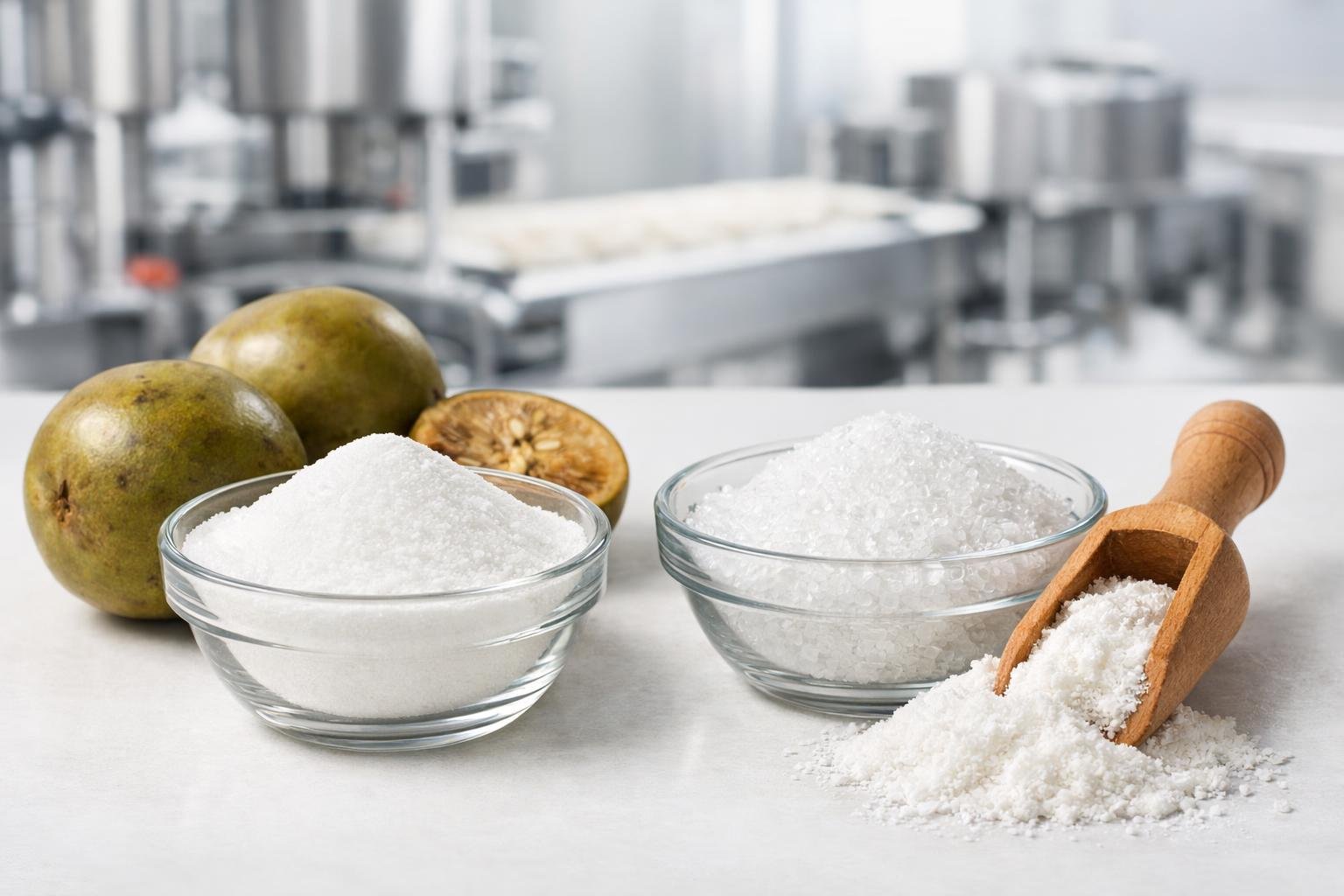
Monk fruit extract is a zero-calorie HIS derived from the Luo Han Guo fruit. The primary active compound, Mogroside V (CAS No.: 88901-36-4; Formula: C60H102O29; Molecular Weight: 1287.43 g/mol), delivers extreme sweetness at low usage levels. Understanding what monk fruit is involves evaluating its history as a natural HIS that replaces sugar without caloric load. It is a favorite among clean-label sugar alternatives due to its high purity and standardized specifications.
Origin And Raw Material
Monk fruit, known botanically as Siraitia grosvenorii and commonly called Luo Han Guo, is a small melon-like gourd native to southern China. The fruit has been used in traditional Chinese medicine for centuries.
Nearly all commercial monk fruit is still grown in the Guangxi and Guangdong provinces of China. The raw fruit is perishable, so it is typically dried or processed into extract shortly after harvest, which concentrates the sweet compounds.
Key Compounds (Mogrosides)
The sweetness in monk fruit comes from a group of triterpene glycosides called mogrosides. The most commercially important is Mogroside V, which is 150 to 250 times sweeter than sucrose.
Food-grade monk fruit extracts are standardized by Mogroside V content. You will commonly find specifications at 25%, 40%, 50%, and 55% Mogroside V. Higher purity levels produce a cleaner taste with less residual fruit flavor.
Production And Extraction Process
After harvest, the dried monk fruit undergoes hot-water extraction. The resulting liquid is filtered and purified to isolate mogrosides from sugars, proteins, and other plant matter.
Further purification through chromatography and membrane filtration yields high-purity Mogroside V concentrates. The final extract is spray-dried into a powder for use in food manufacturing.
Available Forms And Specifications
Monk fruit extract is available in several forms for industrial use:
- Powder: Most common; available in 25%, 40%, 50%, and 55% Mogroside V concentrations.
- Liquid: Concentrated liquid extracts for beverage applications.
- Blends: Pre-blended with erythritol, allulose, or other carriers for easier dosing
You can explore the full range of high intensity sweeteners available for bulk sourcing.
Key Advantages In Manufacturing
Monk fruit’s primary advantage is delivering target sweetness with minimal impact on the formula. You use tiny amounts, typically 0.01% to 0.5% of the total formulation weight.
It is heat- and pH-stable and does not contribute to the caloric content. For beverage applications, it dissolves cleanly and works well as a standalone sweetener or as a sweetness booster in blends.
What Is Allulose?
Allulose (D-Psicose; CAS No.: 551-68-8; Formula: C6H12O6; Molecular Weight: 180.16 g/mol) is a rare sugar monosaccharide that behaves like sucrose with minimal calories. It replicates sugar’s bulking and mouthfeel properties, offering functional versatility and a clean taste profile. The benefits of allulose include its ability to caramelize and its zero glycemic impact. Many developers choose this sugar substitute because it lacks the bitter notes often found in other alternatives.
Definition And Natural Occurrence
Allulose (D-psicose) is a monosaccharide classified as a rare sugar. It occurs naturally in small quantities in figs, raisins, maple syrup, and wheat.
Structurally, it is an epimer of fructose. Your body absorbs allulose in the small intestine but does not metabolize it for energy, so most of it is excreted unchanged.
Commercial Production Process
Commercial allulose is produced through enzymatic conversion of fructose or corn starch-derived fructose. The enzyme D-psicose 3-epimerase catalyzes the conversion of fructose to allulose.
This enzymatic process is scalable and cost-effective for industrial production. The resulting allulose is then purified, concentrated, and either crystallized or spray-dried.
Regulatory Classification
In the United States, allulose holds FDA GRAS (Generally Recognized as Safe) status. The FDA also ruled in 2019 that allulose does not need to be counted as “added sugar” or “total sugar” on Nutrition Facts labels.
In the EU, allulose is still classified as a Novel Food and awaits formal approval. This regulatory gap is important if you are exporting finished products to European markets.
Available Forms And Specifications
Allulose is available in forms that match different production needs:
- Crystalline powder: White, granulated; ideal for baked goods, confectionery, and dry mixes
- Liquid/syrup: 70–75% solids; used in beverages, sauces, and ice cream bases
- Fine powder: For tablet coatings and supplement applications
Key Advantages In Manufacturing
Allulose stands out because it provides bulk and volume at a near 1:1 ratio with sucrose. It caramelizes, participates in Maillard browning, and depresses the freezing point, functions that most other sugar alternatives cannot match.
At about 70% the sweetness of sugar, it often needs a high-intensity sweetener like monk fruit to reach full sugar-equivalent sweetness. This makes it a natural partner in blended sweetener systems.
Manufacturing Process And Supply Chain
Understanding how each sweetener is produced and sourced helps you evaluate supply reliability and lead times. Monk fruit and allulose have very different supply chain structures. These alternative sweeteners require distinct logistics strategies.
Monk Fruit Production And Sourcing Regions
Monk fruit cultivation is concentrated almost entirely in China’s Guangxi province. The growing season is limited, and the fruit must be processed quickly after harvest due to rapid spoilage.
This geographic concentration creates a narrow supply base. Most plant-based sweeteners derived from monk fruit are produced by a relatively small number of processing facilities in this region.
Supply reliability depends heavily on harvest quality, weather conditions, and processor capacity. Working with an established supplier that has direct relationships with growers reduces risk.
Allulose Enzymatic Production And Scalability
Allulose production relies on enzymatic conversion using widely available corn-derived fructose as a starting substrate. This process is not tied to a specific growing region or harvest season.
Production can be scaled by adding more enzymatic reactors. Facilities in China, South Korea, and Japan produce commercial allulose. This broader production base makes the allulose supply chain more resilient than monk fruit’s.
Supply Chain Stability And Global Availability
Monk fruit extract supply can fluctuate based on harvest yields. Strong demand combined with limited growing area has occasionally led to price spikes and longer lead times.
Allulose supply is more predictable because the enzymatic production process runs year-round. Raw material (fructose from corn starch) is abundant and globally traded.
For both ingredients, sourcing from a vertically integrated supplier with in-house production minimizes disruptions.
Impact On Pricing And Lead Times
Monk fruit extract pricing correlates with Mogroside V purity. Higher purity (50%+ MgV) commands premium prices. Lead times typically range from 2 to 6 weeks, depending on specification and order volume.
Allulose pricing has been trending downward as production capacity expands. Lead times are generally 2 to 4 weeks for standard orders. Bulk orders with custom packaging may take longer.
Taste And Sweetness Profile
Taste is where these two sweeteners diverge most sharply, and it is often the deciding factor in formulation. Monk fruit is a high-intensity sweetener with a distinct onset and linger, while allulose tastes remarkably close to sugar at a lower intensity.
Sweetness Intensity Comparison
Monk fruit extract (standardized to Mogroside V) is 150-250 times sweeter than sucrose. You need only fractions of a gram per serving to hit your target sweetness.
Allulose is about 70% as sweet as sugar. To match the sweetness of 100g of sucrose, you need approximately 140g of allulose, or you supplement it with a high-intensity sweetener.
Flavor Profile And Aftertaste
Allulose delivers a clean, sugar-like taste with no detectable aftertaste in most applications. Sensory panels consistently rate it closer to sucrose than almost any other sugar substitute. In the debate of allulose vs monk fruit, the taste profile of allulose is often preferred for neutrality. Formulators often find that the clean allulose taste helps mask the lingering sweetness of other ingredients.
Monk fruit has a slightly fruity onset with a mild lingering sweetness. High-purity extracts (50% Mogroside V and above) have a cleaner profile with less residual flavor. Lower-purity grades may exhibit noticeable fruit or slight bitter notes.
Sensory Differences In Finished Products
In beverages, monk fruit works well as a standalone sweetener or combined with erythritol. The clean water matrix lets you fine-tune sweetness without bulking issues.
In baked goods and confections, allulose integrates seamlessly because it mirrors sugar’s taste and contributes to texture. Monk fruit alone in these matrices often tastes flat or disproportionately sweet without enough body.
Consumer Acceptance Considerations
Consumer familiarity with monk fruit has grown significantly in the US market. It carries strong “natural” and “clean label” associations.
Allulose is relatively new to most consumers, but it scores well in blind taste tests. The fact that the FDA allows it to be excluded from “added sugars” on US labels makes it attractive for products targeting health-conscious buyers. Both ingredients resonate well with keto- and diabetic-friendly consumer segments.
Sugar Equivalence And Dosage In Production
Getting the dosage right is critical for both taste and cost control. Monk fruit and allulose require very different approaches to sugar replacement in food production because of their vastly different sweetness intensities and physical properties.
Monk Fruit Usage Levels And Blending Requirements
Pure monk fruit extract is used at extremely low levels, typically between 0.01% and 0.5% of the total formulation by weight. At 50% Mogroside V concentration, roughly 0.3g to 0.5g replaces the sweetness of 100g of sucrose.
Because monk fruit contributes no bulk, you must pair it with a carrier or bulking agent. Common partners include erythritol, inulin, soluble corn fiber, or allulose itself.
A typical monk fruit erythritol blend for tabletop use might be 0.5% monk fruit extract and 99.5% erythritol by weight.
Allulose Replacement Ratio And Formulation Adjustments
Allulose can replace sucrose at approximately a 1:1 weight ratio for bulking, but it delivers only 70% of the sweetness. This means a formulation using 100g of allulose in place of 100g of sugar will taste noticeably less sweet.
To achieve full sugar-equivalent sweetness, you have two options:
- Use ~130–140g allulose per 100g sucrose (overdosing for sweetness)
- Use 100g allulose plus a small amount of monk fruit or stevia to bridge the sweetness gap
Option 2 is more cost-effective and avoids exceeding digestive tolerance thresholds.
Conversion Reference For Large-Scale Production
| Target | Sucrose | Allulose Alone | Allulose + Monk Fruit |
|---|---|---|---|
| Sweetness equivalence (per 100g sucrose) | 100g | ~135g | 100g allulose + 0.015–0.03g monk fruit (50% MgV) |
| Bulk equivalence (per 100g sucrose) | 100g | 100g | 100g allulose |
| Calorie impact | 400 kcal | ~20–40 kcal | ~20–40 kcal |
These are starting points. Actual ratios depend on your specific matrix, flavor system, and target consumer profile.
Impact On Formulation Cost
Using allulose at high replacement levels increases raw material cost per batch compared to sucrose. Adding a small amount of monk fruit to an allulose base is usually more economical than overdosing allulose for sweetness.
This blending approach also improves taste quality and keeps allulose levels within comfortable digestive tolerance ranges.
Functional Properties In Food Manufacturing
Functional performance in real production environments is where monk fruit and allulose show their biggest practical differences. Allulose behaves like a functional sugar; monk fruit behaves like a flavor ingredient.
Beverage Applications
Monk fruit excels in beverage sweetener solutions because you need only trace amounts to sweeten water-based systems. It dissolves completely, is stable across typical beverage pH ranges (3.0–7.0), and does not affect viscosity or mouthfeel.
Allulose works well in beverages that need body, such as smoothie bases, dairy drinks, and functional beverages. It adds a mild syrupy quality that improves mouthfeel without a significant caloric load.
Bakery And Confectionery Applications
Allulose is the clear leader for bakery and confectionery. It provides structure, moisture retention, and browning, all of which are essential in cookies, cakes, muffins, and candy.
Monk fruit alone cannot fill the structural role of sugar in baked goods. If you use pure monk fruit in a cake formula, you lose volume, texture, and rise. It is best used as the sweetness component in a blend with allulose, erythritol, or fiber-based bulking agents.
Dairy And Frozen Products
In ice cream and frozen desserts, allulose depresses the freezing point similarly to sucrose. This improves scoopability and prevents the hard, icy texture common with other sugar substitutes.
Monk fruit can be used in dairy products for sweetness, but does not contribute to the textural properties you need in frozen or cultured dairy. In yogurt or ice cream, a combination of allulose for texture and monk fruit for a sweetness boost works effectively.
Texture, Mouthfeel, And Bulking Performance
Allulose contributes real bulk at roughly 1:1 with sucrose. It provides mouthfeel, humectancy, and viscosity in your formulation.
Monk fruit has zero bulking capacity. At the usage levels required for sweetness (milligrams per serving), it makes no measurable contribution to texture or mouthfeel. This is the single biggest functional limitation of monk fruit in food manufacturing.
Baking And Processing Performance
Baking and heat processing reveal the sharpest functional contrast between these two ingredients. Allulose actively participates in the chemistry of baking; monk fruit simply survives it.
Caramelization And Browning Behavior
Allulose undergoes both the Maillard reaction and caramelization when heated. This is rare among sugar alternatives and is one of allulose’s most valued properties. You get golden-brown cookies, properly crusted breads, and caramelized toppings without using sucrose.
Monk fruit does not participate in browning reactions. Products sweetened only with monk fruit (plus a non-browning carrier like erythritol) will be pale in appearance unless you add coloring agents or browning aids.
Heat and pH Stability
Both ingredients are heat-stable through typical baking temperatures (up to 200°C / 400°F). Neither degrades nor loses sweetness during standard processing.
Both are stable across the pH range used in most food applications (pH 3–7). You will not see sweetness loss or off-flavors from pH-related degradation in either ingredient.
Moisture Retention And Shelf Life Impact
Allulose is hygroscopic, meaning it attracts and holds moisture. This helps baked goods stay soft and extends shelf life by slowing staling.
Monk fruit extract has minimal hygroscopic effect at the small quantities used. Moisture retention in monk fruit-sweetened baked goods depends on the bulking agent, not the monk fruit itself.
Suitability For Industrial Processing
Allulose handles well in continuous mixing, extrusion, enrobing, and high-shear processing. It dissolves readily and does not crystallize unpredictably in most food systems.
Monk fruit extract, being used in such small amounts, disperses easily in liquid or dry blends. Uniform distribution at low inclusion levels requires adequate pre-blending or dilution in a carrier. In large-scale production, pre-blended monk fruit formulations reduce dosing variability.
Formulation Challenges And Solutions
Every sweetener has limitations. Knowing the specific weaknesses of monk fruit and allulose, and how to address them, is what separates a workable bench formula from a successful production run.
Monk Fruit Limitations And Solutions
No bulk: Monk fruit cannot replace the physical mass of sugar. Pair it with erythritol, allulose, inulin, or soluble fiber to restore volume and texture.
Off-notes at high concentration: Lower purity monk fruit extracts (25% MgV) can carry fruity or slightly bitter notes. Switching to 50%+ MgV grades significantly reduces off-flavors. Monk fruit aftertaste masking is also achieved through strategic blending.
Dosing precision: At milligram-level inclusion rates, small errors cause big taste swings. Use pre-diluted blends or master batches for consistent dosing in production.
Allulose Limitations And Solutions
70% sweetness: Allulose alone falls short of sugar sweetness. Bridge the gap with a small addition of monk fruit, stevia, or another high-intensity sweetener rather than increasing allulose quantity.
Digestive tolerance: Intake above approximately 50g per serving can cause GI discomfort in some individuals. Keep per-serving allulose levels moderate and use a sweetness booster to compensate.
Crystallization in some applications: In high-concentration syrups or confections, allulose may crystallize over time. Controlling water activity and adding small amounts of other sugars or fibers can prevent this.
Blending Strategies For Optimized Taste And Cost
The most effective sweetener blending strategy for many applications is an allulose base with a monk fruit sweetness boost. This approach:
- Provides bulk and browning (from allulose)
- Reaches full sugar-equivalent sweetness (from monk fruit)
- Keeps allulose levels within digestive comfort zones
- Reduces overall cost-in-use versus overdosing allulose
An allulose-erythritol blend is another popular option when you want a firmer texture or a lower-cost base.
Use Of Complementary Ingredients
Soluble corn fiber, inulin, and polydextrose can supplement bulking when you want to further reduce allulose levels. Natural flavors, vanilla, or citric acid can help round out sweetness and mask any residual off-notes from monk fruit.
Cost Analysis For Bulk Buyers
Cost-in-use, not price per kilogram, is the metric that matters when comparing monk fruit vs allulose for large-scale production. The raw price tag can be misleading because these two sweeteners are used at radically different levels.
Price Per Kg Comparison
As of 2026, bulk monk fruit extract pricing typically ranges from $80 to $300+ per kg, depending on Mogroside V concentration. Higher purity commands higher prices.
Bulk allulose powder generally ranges from $3 to $8 per kg, depending on volume, grade (crystalline vs. syrup), and supplier. Allulose pricing has been declining as global production capacity increases.
Cost-In-Use Based On Sweetness And Dosage
To sweeten one metric ton of finished product to sugar equivalence:
| Sweetener | Approximate Usage | Estimated Cost |
|---|---|---|
| Sucrose | ~100 kg | ~$50–80 |
| Allulose (alone, overdosed) | ~135 kg | ~$400–1,080 |
| Allulose + Monk Fruit (50% MgV) | 100 kg allulose + 15–30g monk fruit | ~$320–850 |
| Monk Fruit + Erythritol blend | 100 kg erythritol + 15–30g monk fruit | ~$250–650 |
These are indicative ranges. Actual costs depend on your negotiated pricing, specification, and application.
Cost Impact In Different Applications
In beverages, monk fruit is often the most cost-effective option because you use tiny quantities in a high-water matrix.
In baked goods and confectionery, allulose-based formulations are costlier than sucrose but deliver the functional performance you need. The allulose plus monk fruit blend typically costs less than using allulose alone to match full sweetness.
Strategies To Optimize Formulation Cost
- Use monk fruit as a sweetness booster rather than a standalone sweetener in solid food applications
- Blend allulose with lower-cost bulking agents (erythritol, fiber) to reduce the proportion of allulose needed
- Source higher Mogroside V grades to reduce total monk fruit usage
- Lock in pricing with annual supply agreements to hedge against raw material fluctuations
Bulk Supply, MOQ, and Lead Time
Sourcing sweetener ingredients at scale requires planning around minimum order quantities, production schedules, and logistics timelines. Both monk fruit and allulose have different supply dynamics.
Typical Minimum Order Quantities
For bulk monk fruit extract, typical MOQs range from 25 kg to 500 kg, depending on the specification and supplier. Specialty grades (55% MgV or above) may have higher MOQs due to production batch sizes.
Bulk allulose powder MOQs generally start at 500 kg to 1 metric ton for standard crystalline grades. Liquid allulose may have higher MOQs due to shipping weight.
Production Lead Times
Standard monk fruit extract orders typically ship within 2 to 4 weeks from order confirmation. Custom blends or non-standard Mogroside V specifications may require 4 to 6 weeks.
Allulose lead times are generally 2 to 4 weeks for standard crystalline powder. Custom packaging or liquid formats may add 1 to 2 weeks.
Packaging Options
Common packaging for both ingredients includes:
- 25 kg fiber drums (standard for monk fruit extract)
- 25 kg kraft paper bags with PE liner (common for allulose)
- 500 kg or 1 MT super sacks (for large-volume allulose orders)
- Custom packaging for private label or OEM requirements
Export And Logistics Considerations
Both ingredients are typically exported from China via ocean freight. Transit time to US West Coast ports is approximately 2 to 3 weeks; East Coast takes 4 to 5 weeks.
Your supplier should provide full export documentation, including Certificate of Analysis (COA), Certificate of Origin, phytosanitary certificates where required, and all relevant food safety certifications. Working with a supplier experienced in global food ingredient logistics reduces customs delays and compliance issues.
Certifications And Quality Standards
When importing food-grade sweeteners in bulk, certifications are mandatory. They are your assurance of quality, safety, and market access.
Common Certifications: ISO, Halal, Kosher, Non-GMO, BRC
The certifications you should expect from a reputable bulk sweetener supplier include:
- ISO 9001 (Quality Management)
- ISO 14001 (Environmental Management)
- ISO 22000 / FSSC 22000 (Food Safety Management)
- BRC (Global Standard for Food Safety)
- SQF (Safe Quality Food)
- Halal and Kosher certification
- Non-GMO Project Verified or IP Non-GMO Supply Chain certification
- FDA registration (for US import)
BSH Ingredients holds all of these certifications, which is essential for buyers sourcing across regulated global markets.
Food-Grade Compliance
Both monk fruit extract and allulose must meet food-grade purity specifications. Key quality parameters include moisture content, ash content, heavy metals limits, microbiological counts, and active compound concentration (Mogroside V for monk fruit; D-allulose purity for allulose).
Every shipment should include a detailed Certificate of Analysis matching your agreed specifications.
Documentation For Import/Export
For US import, you need an FDA prior notice filing, a COA, product specification sheets, and allergen statements. Some buyers also require third-party lab verification.
For other markets, documentation requirements vary. Halal and Kosher certificates may be mandatory depending on your target distribution channel.
Importance For Global Buyers
Incomplete certifications create delays, rejected shipments, and lost revenue. Always verify that your supplier’s certifications are current and audited by recognized bodies. This is especially important for natural sweeteners sourced from China, where certification standards can vary between suppliers.
Regulatory Status And Labeling
Regulatory classification directly affects how you label your finished product and which markets you can sell into. Monk fruit and allulose have different regulatory profiles across major markets.
Regulatory Status In Major Markets
| Market | Monk Fruit | Allulose |
|---|---|---|
| USA | FDA GRAS | FDA GRAS; excluded from “added sugars” and “total sugars” |
| EU | Approved | Not approved (Novel Food application pending) |
| Canada | Approved | Approved |
| Japan | Approved | Approved |
| South Korea | Approved | Approved |
| Australia/NZ | Approved | Under review |
If you are manufacturing products for export to the EU, allulose is currently not an option in your formulation. Monk fruit is the safer choice for global distribution.
Labeling Differences In Finished Products
In the US, monk fruit appears on ingredient labels as “monk fruit extract” or “Luo Han Guo fruit extract.” It counts as zero calories and zero sugars.
Allulose is listed as “allulose” on US labels. Per FDA guidance, it does not count toward total sugars or added sugars on the Nutrition Facts panel, though it may still appear in the total carbohydrate line. This labeling treatment is a significant advantage for products that target sugar-reduction claims.
Clean Label Considerations For Brands
Both ingredients are considered clean-label sweeteners. Monk fruit has a slight edge in consumer perception as a “natural fruit extract.”
Allulose, while commercially produced via enzymatic conversion, is a naturally occurring sugar and reads well on labels. Neither ingredient triggers the consumer skepticism associated with artificial sweeteners like aspartame or sucralose.
Stability, Shelf Life, and Storage
Proper storage and handling directly affect the quality and performance of your sweetener ingredients throughout their shelf life and during processing.
Storage Conditions
Both monk fruit extract and allulose should be stored in a cool, dry environment, ideally below 25°C (77°F) with relative humidity below 60%.
Allulose is more hygroscopic than monk fruit extract. Keep allulose containers tightly sealed to prevent moisture absorption and clumping. Monk fruit extract powder is less prone to moisture uptake but should still be protected from humidity.
Shelf Life Comparison
Properly stored monk fruit extract has a shelf life of 24 to 36 months. The mogrosides are chemically stable and do not degrade significantly under standard warehousing conditions.
Allulose powder also carries a 24-month shelf life when stored correctly. Liquid allulose (syrup form) may have a slightly shorter shelf life and requires more careful temperature management.
Stability During Transportation And Processing
Both ingredients withstand typical ocean freight conditions without degradation, provided containers are properly sealed and desiccants are used where needed.
During food processing, both ingredients maintain their sweetness and functional properties through pasteurization, UHT treatment, baking, and extrusion. Allulose’s browning behavior is the only heat-induced change, and it is a desired functional property rather than a defect.
Digestive Tolerance And Safety
Consumer safety and comfort are non-negotiable. Both monk fruit and allulose are well-tolerated, but there are practical limits you should build into your formulation.
Tolerance Levels For Each Ingredient
Monk fruit extract has excellent digestive tolerance. At the extremely low usage levels required for sweetness (milligrams per serving), there are no reported gastrointestinal effects.
Allulose is well-tolerated at moderate intake levels. Studies indicate that most adults can consume up to 0.4g per kg of body weight per eating occasion without GI discomfort. For a 70 kg adult, that is about 28g per sitting. Intake above 50g in a single serving may cause bloating, gas, or loose stools in sensitive individuals.
Potential Side Effects
Monk fruit has no known side effects at normal food-use levels.
Allulose in very high doses can cause mild gastrointestinal symptoms similar to other sugar alcohols, though generally less severe than erythritol or xylitol at equivalent doses. Keeping per-serving allulose levels reasonable and using a high-intensity sweetener to reach the target sweetness eliminates this concern in most formulations.
Suitability For Different Consumer Groups
Both ingredients have a Glycemic Index of zero and do not raise blood glucose or insulin levels. This makes them suitable for diabetic friendly sugar alternatives, ketogenic diets, and weight management products.
Both are considered safe for children and pregnant women at typical food-use levels. Neither ingredient has allergenic properties nor contains common allergens.
Market Trends And Industry Demand
The demand for both monk fruit and allulose is growing rapidly, driven by global sugar reduction initiatives and consumer preference for clean-label, low-calorie, and keto-friendly products.
Growth In Sugar Reduction Initiatives
Government-driven sugar taxes in countries like the UK, Mexico, and several Southeast Asian markets are accelerating reformulation efforts across the food and beverage industry. Manufacturers need sugar substitutes that maintain taste and texture, which is fueling demand for functional alternatives like allulose.
The global monk fruit sweetener market was valued at approximately $354 million in 2023 and is projected to reach $592 million by 2030, growing at a CAGR of 7.6%.
Demand for Low-Calorie And Keto Products
The keto and low-carb product segment continues to grow, particularly in the US. Both monk fruit and allulose qualify as keto-friendly sweeteners with zero net carbs.
Allulose has seen particularly rapid adoption in keto baked goods, ice cream, and protein bars due to its sugar-like functionality. The global allulose plus monk fruit blend market reached $1.43 billion in 2024, reflecting the popularity of synergistic sweetener systems.
Industry Adoption Trends
Major CPG brands and fast-growing DTC health brands are increasingly using monk fruit and allulose either independently or in combination. The debate over natural vs. artificial sweeteners is no longer a niche conversation; it is the mainstream direction of product development.
Contract manufacturers and OEM producers are building formulation expertise around these ingredients to serve the growing pipeline of reformulated and new product launches.
Alternative Sweeteners For Comparison
Monk fruit and allulose are not your only options in the world of alternative sweeteners. Each HIS and sugar alternative has unique properties. Here is how they compare with three other options frequently used in modern food formulation. Knowing when to use an HIS versus a rare sugar is key to formulation.
Stevia
Stevia (steviol glycosides) is another zero-calorie, plant-based HIS. It is 200 to 300 times sweeter than sugar but carries a bitter, licorice-like aftertaste that many consumers dislike.
Monk fruit generally scores higher in consumer acceptance due to its cleaner taste profile. Stevia is less expensive per kg than monk fruit extract, but may require more taste masking in formulation.
Erythritol
Erythritol is a sugar alcohol with about 60–70% of sugar’s sweetness and nearly zero calories. It provides good bulking and a cooling mouthfeel, but does not brown or caramelize.
It is commonly used as a carrier for monk fruit in tabletop and blended sweetener products. Erythritol is less expensive than allulose but does not replicate sugar’s functional properties as closely, particularly in baking.
Xylitol
Xylitol is another sugar alcohol with a sweetness similar to sucrose. It has about 2.4 calories per gram and provides a noticeable cooling effect.
Xylitol is toxic to dogs, which limits its use in products that may be accessible to pets. It is also more likely to cause GI distress than allulose at equivalent doses. Its use in food manufacturing is declining relative to allulose for these reasons.
Decision Guide For Food Manufacturers
Choosing between monk fruit, allulose, or a combination depends on your specific application, target market, regulatory scope, and cost targets.
When To Choose Monk Fruit
Choose monk fruit when:
- You are formulating zero-calorie beverages (teas, flavored waters, functional drinks)
- Your product needs minimal sweetener volume (supplements, flavor enhancers)
- You want the strongest clean label perception
- You are selling into both the US and EU markets
- Cost-in-use efficiency at high sweetness intensity is your priority
When To Choose Allulose
Choose allulose when:
- You need sugar-like bulking, texture, and browning (baked goods, confectionery)
- Your product is a dairy or frozen dessert requiring freezing point depression
- You are formulating syrups, sauces, or honey alternatives that need viscosity
- Your market is the US, Canada, Japan, or South Korea (approved markets)
- You want to leverage the FDA’s favorable sugar labeling exclusion
When To Combine Both
Combine monk fruit and allulose when:
- You need both bulk and full sugar-equivalent sweetness
- You want to minimize allulose usage to stay within digestive comfort levels
- You are developing premium keto or diabetic friendly products
- You want to optimize cost-in-use while maintaining taste and functionality
Application-Based Recommendations
| Application | Recommended Sweetener |
|---|---|
| RTD beverages | Monk fruit (standalone or with erythritol) |
| Cookies, cakes, muffins | Allulose + monk fruit |
| Ice cream, frozen desserts | Allulose + monk fruit |
| Protein bars | Allulose + monk fruit or fiber blend |
| Tabletop sweetener | Monk fruit + erythritol blend |
| Sauces and dressings | Allulose (liquid form) |
| Supplements and capsules | Monk fruit extract (high purity) |
| Confectionery and candy | Allulose + monk fruit |
Can Monk Fruit And Allulose Be Used Together
Combining monk fruit with allulose is one of the most effective sweetener blending strategies available to food manufacturers. It addresses each ingredient’s weaknesses while amplifying its strengths.
Benefits Of Combined Use
Allulose provides the body, bulk, browning, and mouthfeel that sugar delivers. Monk fruit fills the 30% sweetness gap that allulose cannot reach on its own.
Together, they create a synergistic sweetener system that closely replicates sucrose in taste and function while keeping calories near zero, maintaining a zero glycemic impact, and delivering clean label appeal.
Formulation Strategies
A practical starting point for an allulose plus monk fruit blend in baking:
- Allulose: 100% of sugar weight replacement
- Monk fruit extract (50% MgV): 0.01–0.03% of total batch weight to bring sweetness to the target
Adjust monk fruit levels based on sensory evaluation. Start at the lower end and increase incrementally. In beverages, you may invert this ratio, using primarily monk fruit with a small amount of allulose for body.
Examples In Commercial Products
Monk fruit and allulose blends are appearing in an increasing number of commercial products: keto cookies, low-sugar ice cream, sugar-free chocolate, protein bars, and functional beverages.
Many leading health and wellness brands now list both “allulose” and “monk fruit extract” on their ingredient panels, confirming the market validation of this synergistic approach.
Why Choose BSH Ingredients
BSH Ingredients combines manufacturing scale, technical capability, and global quality certifications to serve food manufacturers sourcing bulk sweetener ingredients from China.
Large-Scale Production And Export Capability
BSH Ingredients operates large-scale fermentation and extraction facilities in China with dedicated production lines for sweetener ingredients. The company has an established export infrastructure serving buyers in the US, Europe, Asia, and the Middle East.
Full Range Of Specifications
You can source monk fruit extract in 25%, 40%, 50%, and 55% Mogroside V concentrations, plus allulose in crystalline powder, fine powder, and liquid syrup formats. This range allows you to match your exact formulation needs.
Certifications And Quality Assurance
BSH Ingredients holds ISO 9001, ISO 14001, ISO 22000, BRC, SQF, Halal, Kosher, FDA registration, and Non-GMO IP supply chain certification. Every batch ships with a full Certificate of Analysis.
OEM And Custom Formulation Support
The company provides OEM sweetener blending and private label sweetener manufacturing services. If you need a custom monk fruit plus allulose blend, a monk fruit erythritol blend, or any other formulation, BSH’s technical team can develop it to your specification.
Stable Global Supply
With in-house production and strong sourcing of raw materials from China’s primary growing regions, BSH Ingredients delivers consistent supply stability. Annual contracts and rolling forecasts help you secure pricing and lead times.
Free Samples And Competitive Pricing
BSH provides free samples of all sweetener specifications for evaluation before you commit to bulk orders. Pricing is competitive at scale, and the company offers flexible MOQs to support both large manufacturers and growing brands.
Conclusion
Monk fruit is a zero-calorie, high-intensity sweetener best suited for beverages, supplements, and applications where you need extreme sweetness without bulk. Allulose is a rare sugar that mimics sucrose in function, providing bulk, browning, and mouthfeel at about 70% sweetness.
Neither is universally “better.” Each serves a distinct purpose in food manufacturing formulation.
If you are formulating beverages or supplements, start with monk fruit. If you are formulating baked goods, dairy, frozen desserts, or confectionery, start with allulose. For the most sugar-like result with the best cost efficiency, blend both.
If you are ready to evaluate monk fruit or allulose for your next product, request free samples and bulk pricing from BSH Ingredients. Their technical team can also help you develop custom blends matched to your application, production scale, and target market. Contact BSH Ingredients to get started.
Frequently Asked Questions
How do monk fruit sweeteners and an allulose sweetener compare in sweetness, flavor profile, and aftertaste in finished products?
Monk fruit extract is 150 to 250 times sweeter than sugar and carries a slight fruity character with a mild linger, especially at lower purity grades. Allulose is only 70% as sweet as sugar but tastes remarkably close to sucrose with no detectable aftertaste, making it the better choice when a sugar-identical taste is critical.
Which performs better in baking and confectionery for browning, texture, moisture retention, and freeze-thaw stability?
Allulose is the clear winner for baking and confectionery. It participates in Maillard browning, caramelizes properly, retains moisture to extend shelf life, and depresses the freezing point to improve the texture of frozen desserts. Monk fruit does not contribute to any of these functions and requires a bulking agent to be used in baked goods.
How do monk fruit and allulose impact blood glucose, insulin response, and suitability for diabetic-friendly formulations?
Both have a glycemic index of zero and do not raise blood glucose or insulin levels. Both are suitable for diabetic-friendly sugar alternatives, keto formulations, and weight-management products. Allulose is absorbed but not metabolized; monk fruit is used in such small amounts that the metabolic impact is negligible.
What are the cost-in-use differences between monk fruit and allulose when targeting sugar-equivalent sweetness at scale?
Monk fruit has a high per-kg price ($80–$300+) but extremely low cost-in-use because you need only milligrams per serving. Allulose is much cheaper per kg ($3–$8) but is used at nearly 1:1 sugar weight, so batch costs are higher. Blending allulose with a small amount of monk fruit typically delivers the best cost-in-use balance.
What labeling, regulatory status, and claim considerations apply to monk fruit and allulose across major markets?
Both are FDA GRAS in the US. Allulose has the added advantage of being excluded from “added sugars” and “total sugars” on US labels. In the EU, monk fruit is approved, but allulose is not yet authorized as it is still under Novel Food review. For global distribution, monk fruit offers broader regulatory clearance.
When does blending monk fruit with allulose improve taste and functionality compared with using either sweetener alone?
Blending is most beneficial when you need both bulk and full sweetness, such as in baked goods, ice cream, confectionery, and protein bars. Allulose provides the body and browning, while monk fruit bridges the sweetness gap. This combination also keeps allulose per-serving levels within comfortable digestive tolerance ranges and reduces overall formulation cost compared to overdosing either ingredient.


